







Tru-Tone Christmas Lights: Your Questions, Answered
What makes Tru-Tone different, Classicolor or Jeweltone, 10 or 25 lights, how many you need, outdoor use, plugging sets together, and what to do when a bulb goes out.
Tru-Tone lights are LED Christmas bulbs made to look like the old “big bulb” incandescent lights: the same C7 shape, the same colors and the same warm glow, without the heat. We carry Tru-Tone’s C7 Classic Light Set in three versions — Classicolor 10-Light ($29.95), Classicolor 25-Light ($64.95) and Jeweltone 10-Light ($30.95) — each in Tru-Tone’s vintage-style gift box. Below are the questions we get most, answered with Tru-Tone’s own specs. Everything here is in stock.
In this guide

Top: ordinary LED Christmas lights. Bottom: the same house with Tru-Tone. Photos: Tru-Tone
What makes them different
LED bulbs that don’t look like LEDs.
Tru-Tone began as a passion project for designer David Andora, who wanted the “big bulb” Christmas lights from his childhood without the burnt fingers, blown fuses and smoldering trees. The LED Christmas lights on the market were all saturated, electronic colors, so he spent a year and a large chunk of his savings working with manufacturers on the wattage, brightness, color temperature, glass shape and color coatings until the bulb was, in Tru-Tone’s words, “nearly indistinguishable from vintage incandescent.”
The difference is the filament. Each bulb has Tru-Tone’s own extra-warm LED filament, made to match the brightness, warmth and shape of an old tungsten one, inside a C7 bulb shaped like GE’s originals. The glass Classicolor bulbs are colored with the same kind of coatings vintage bulbs used.
CHROME tipLook at the photo again: ordinary LEDs turn a house blue and purple. Tru-Tone stays warm, the way Christmas lights used to look.

Classicolor (left) and Jeweltone (right). Photos: CHROME
Classicolor or Jeweltone?
Two looks, both vintage.
Classicolor is the opaque, ceramic-style bulb — red, orange, green, blue and white, soft and even, the look most people picture when they think of old Christmas lights. These are traditional glass bulbs.
Jeweltone is the transparent bulb you can see the filament through, in red, amber, green, blue and magenta. Ours are Tru-Tone’s Dura-Bulbs: shatterproof, colorfast and weathertight, with the color infused into UV-stabilized polycarbonate so it can’t flake or scratch off. Tru-Tone made them to glow and color like its glass bulbs, for the same price.
CHROME tipInside on the tree, either one. Outside, or anywhere a glass bulb might get knocked, go Jeweltone.
Shop Tru-Tone & vintage Christmas
Shop Vintage Christmas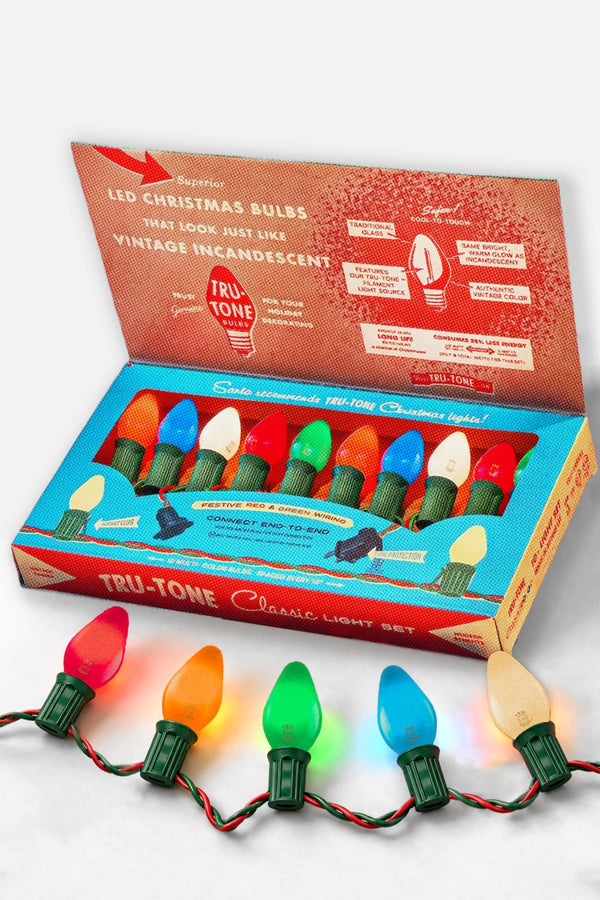
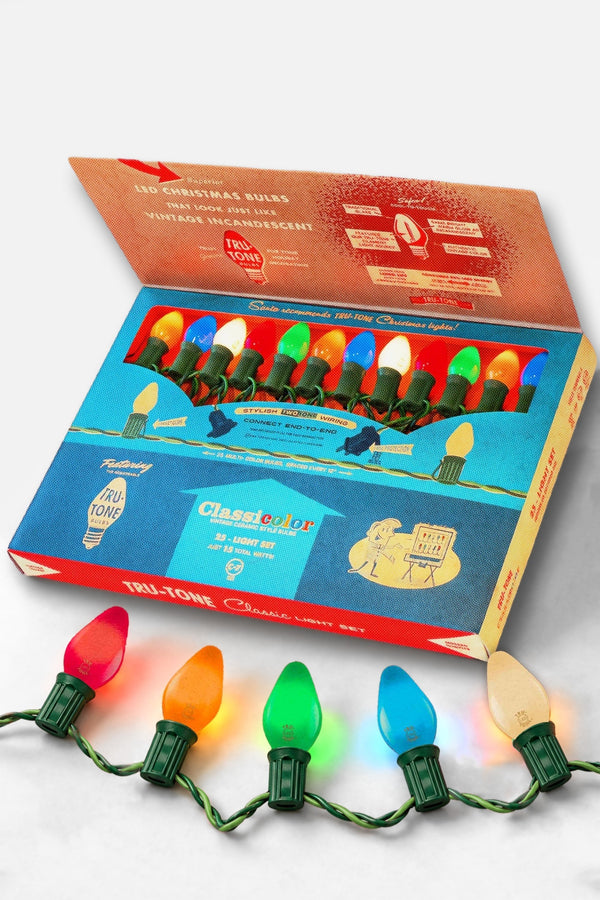
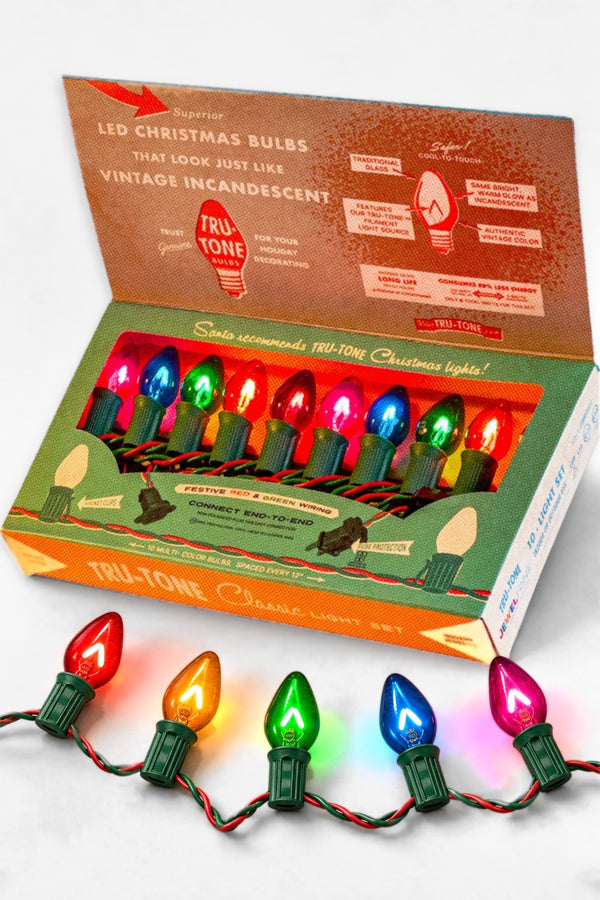
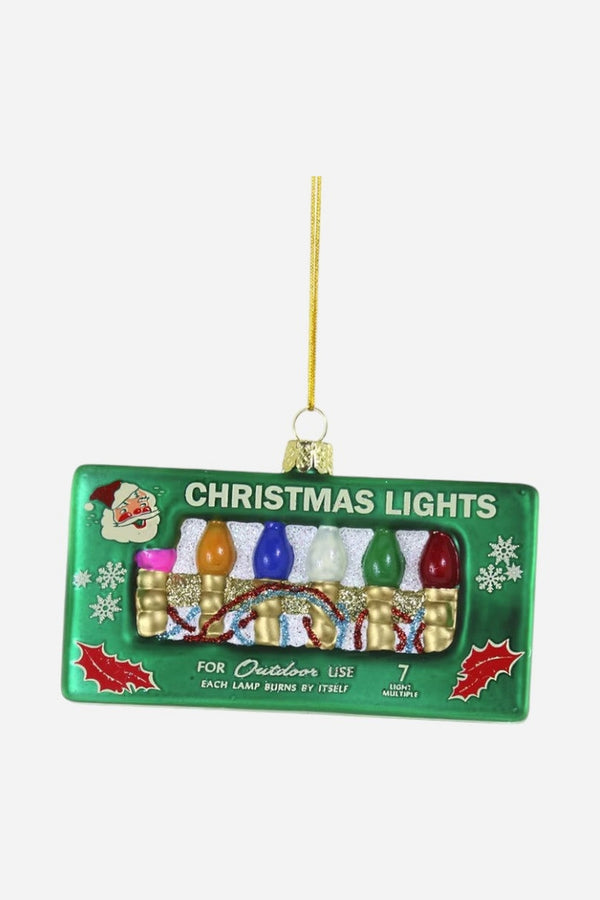

The Classicolor 25-Light set, on two-tone green wire. Illustration: Tru-Tone
10 or 25 lights?
Measure first.
Both sets have sockets every 12 inches, an 18-inch lead before the first bulb and a 12-inch tail. That makes the 10-Light set about 11½ feet long and the 25-Light about 26½ feet. The 10-Light sets come on festive red and green wire; the 25-Light Classicolor is on two-tone green. Every socket has a clip.
For a tree, Tru-Tone’s rule of thumb is height × width at the base (in feet) × 4 for a light tree, × 5 for medium and × 6 for full, then round to the nearest 25. A 6½-foot tree that’s 3½ feet wide comes to about 114 bulbs at medium — five 25-Light sets. For a window or a rail, you need one bulb per foot.
CHROME tipThe 10-Light set is the one for a wreath, a mantel or a small tree — and the gift. The 25-Light is for the tree.

Tru-Tone’s water test on a Dura-Bulb. Don’t try this at home. Photo: Tru-Tone
Can they go outside?
Yes, with a little care.
Tru-Tone bulbs and Classic Light Strings are safe to use outdoors. The bulbs are sealed with corrosion-resistant bases and can handle cold weather and rain with reasonable care. Point the bulbs down where you can; upward-facing bulbs and sockets are more exposed to water.
The colored coating on glass bulbs sits on the outside, so Tru-Tone recommends hanging the string first and screwing the bulbs in after, to keep them off the shingles. Sun is the biggest cause of fading: take the lights down at the end of the season, and know that on the glass Classicolor bulbs, orange is the first color to show it. Dura-Bulbs are made to resist fading. The vintage-style strings are best seen up close — porch rails, windows, doorways, a front-yard tree — and for a long roofline Tru-Tone suggests standard bulk string.
CHROME tipOutside, use the Jeweltone Dura-Bulb set and take it down in January. It’ll look new next Christmas.

Classicolor 25-Light, lit. Photo: CHROME
Power & dimmers
The part you never had to think about with old bulbs.
Each bulb uses about 0.6 watts — Tru-Tone says 88% less energy than incandescent — and stays cool enough to touch, so it won’t dry out the tree or melt a decoration. A 10-Light set draws 6 watts and a 25-Light set 15. The plugs stack end to end, and you can connect up to 24 of the 25-Light sets (600 bulbs) on one run, up to 360 watts or 3 amps. The plug is non-polarized and fused, with two spare fuses in the box.
They’re fully dimmable with most standard or LED dimmers (not included). You can also mix Tru-Tone bulbs with your old incandescent or LED bulbs on the same string; just keep each socket under 7 watts on the Classic Light String and the whole run under 360.
CHROME tipTru-Tone’s one rule we’ll repeat: resist the urge to wrap the lights around your loved ones, however adorable they look.

Packed in a vintage-style box with a flap-lid window. Photo: Tru-Tone
When a bulb goes out
Usually a two-minute fix.
One bulb dark: move it to a socket you know works. If it lights, the first one wasn’t screwed in all the way, or went in at an angle — back it out and thread it again, straight. If it still won’t light, the bulb needs replacing.
The whole string dark: it’s almost always a fuse. Unplug the string; the fuses are in the plug. It takes two 3.6 × 10 mm quick-acting 3-amp fuses, the same ones common mini-light strings use, and the spares are in a small packet near the plug. If the new fuses blow right away, look for a short: start with an empty string and add bulbs one at a time until you find the one that trips it. Always unplug before you touch a socket.
CHROME tipPlug every set in and check it before it goes on the tree. A loose bulb is a lot easier to find on the floor than on a branch.

How to light a tree with Tru-Tone, in five steps
- Measure the treeHeight × width at the base, in feet, × 4, 5 or 6 for light, medium or full.
- Round to 25-Light setsRound the bulb count to the nearest 25. Use the 10-Light set to fill a gap.
- Plug them together firstConnect the sets end to end and check every bulb lights before anything goes on the tree.
- Work from the trunk outStart low near the outlet and clip each socket near the tip of a branch.
- Dim for the eveningTru-Tone bulbs are fully dimmable. Turn them down for a softer glow at night.
Putting them away
- Unscrew the bulbs and put them back in the box they came in. That’s the safest place for them until next year.
- If you leave the bulbs in, coil the string loosely with foam or fabric between layers so the bulbs don’t knock together.
- Clean glass bulbs with a damp microfiber cloth, never anything abrasive.
- Store them somewhere dry and cool, not a hot attic or a damp garage.


